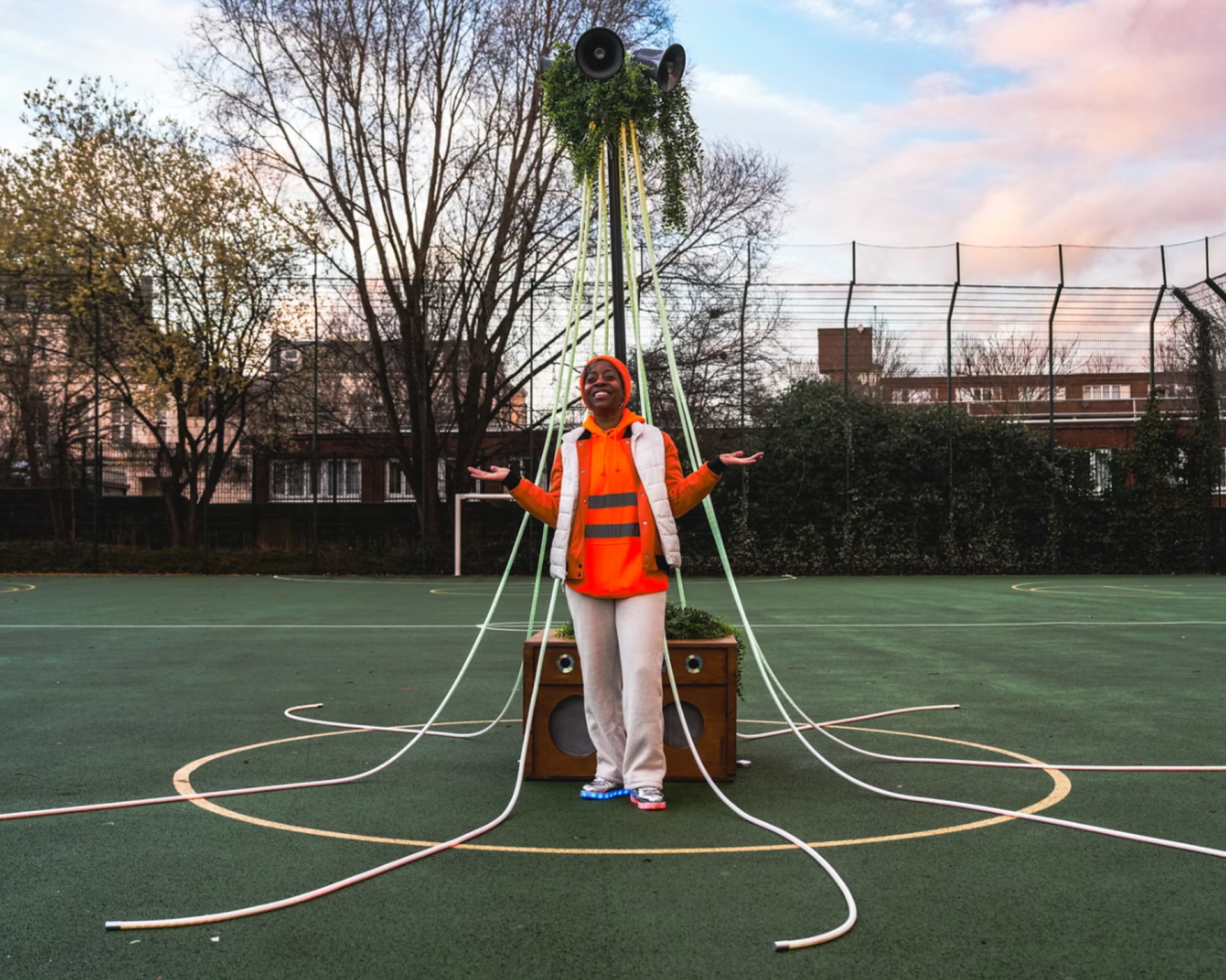
Some 40 years later, in early 2020, Kamala unexpectedly came across a maypole again, leaning against the corner of a school classroom in Jamaica. To her surprise, a teacher there told Kamala that the children still dance around the maypole most days after school, and that day Linett watched in awe as the girls bobbed and weaved in rhythm. They giggled while intricately plaiting and unplaiting the ribbons, while classic mento music pumped out of a teacher’s car stereo. “I was just elevated,” Linett says. “I felt connected. I wasn’t just reconnecting to this place geographically, because this region was where my father came from, but there was this tradition that they’d kept going and made it their own.”
The bliss that she saw among the girls, and the warm nostalgia she felt, was challenging in relation to how she felt about this colonial leftover. Kamala knew she had to somehow bring a maypole into her art practice, so she bought an old one online, and began hosting workshops at the Kilburn community centre that she volunteers at, introducing local people to the dance and its history. That’s when a grander artistic vision began to come into focus: to make her own maypole, in her own style, for her own community and thus, the Basstone Maypole was born.
This is Kamala’s very own fantastical, sci-fi-inspired maypole. It features programmed LED light strings instead of ribbons, school Tannoy speakers on the crown, and a thunderous bass bin on the bottom. A “light and sound system”, she calls it. After unveiling it in February at the Light Up Kilburn festival, “I was inundated,” she recalls, as “kids, parents, elders” flocked to it along with some ageing ravers.
Beverley Bogle is a Jamaican quadrille dancer and facilitator who moved to the UK in the 60s at the age of 16. The retired lecturer and NHS nurse teaches about this dance that originated in 18th-century Europe and was also brought to Jamaica by the British during slavery.
“They took our names, our music, our clothes, our beliefs, our freedom. They treated us like we weren’t human,” she says of her enslaved ancestors in Jamaica. “So we took their dance and we made it our own” – just as they did with the maypole. There’s defiance and empowerment in the dance, she explains, as it originates from Africans mimicking the white colonisers, “creatively changing it into their own styles of quadrille dance, with improvised musical accompaniment”. Although it was strictly forbidden, she tells us, “they secretly danced their quadrille in their camps at night to keep their spirits high, support each other in their plight for human dignity and equality, and most importantly to communicate their shared plans for emancipation and hope for a better lifestyle”. She adds: “We dance now to celebrate our ancestors’ survival strategies and their eventual triumph over oppression.”
It is clear that English folk traditions are more complicated, rich and cross-cultural than many realise: a history as tangled as maypole ribbons, standing somewhere between the darkness of winter and the lightness of spring.
“To me, it’s all about visibility,” Linett says. “There’s more to sound system culture, Jamaican culture and English culture than people think.”
Linett Kamala’s Basstone Maypole will appear at festivals and events this year, to be announced. Her solo exhibition Dancehall Riddim Queens featuring archival works, is at Iniva, Stuart Hall Library, London, from 29 April to 31 July