NEWS
Assam’s Living Heritage, Sattriya and Bihu Takes Centre Stage at Chelsea and Westminster Hospital in London
The special Akademi showcase highlighted Assam’s rich cultural heritage while bringing joy, connection and respite to the hospital community.
Share
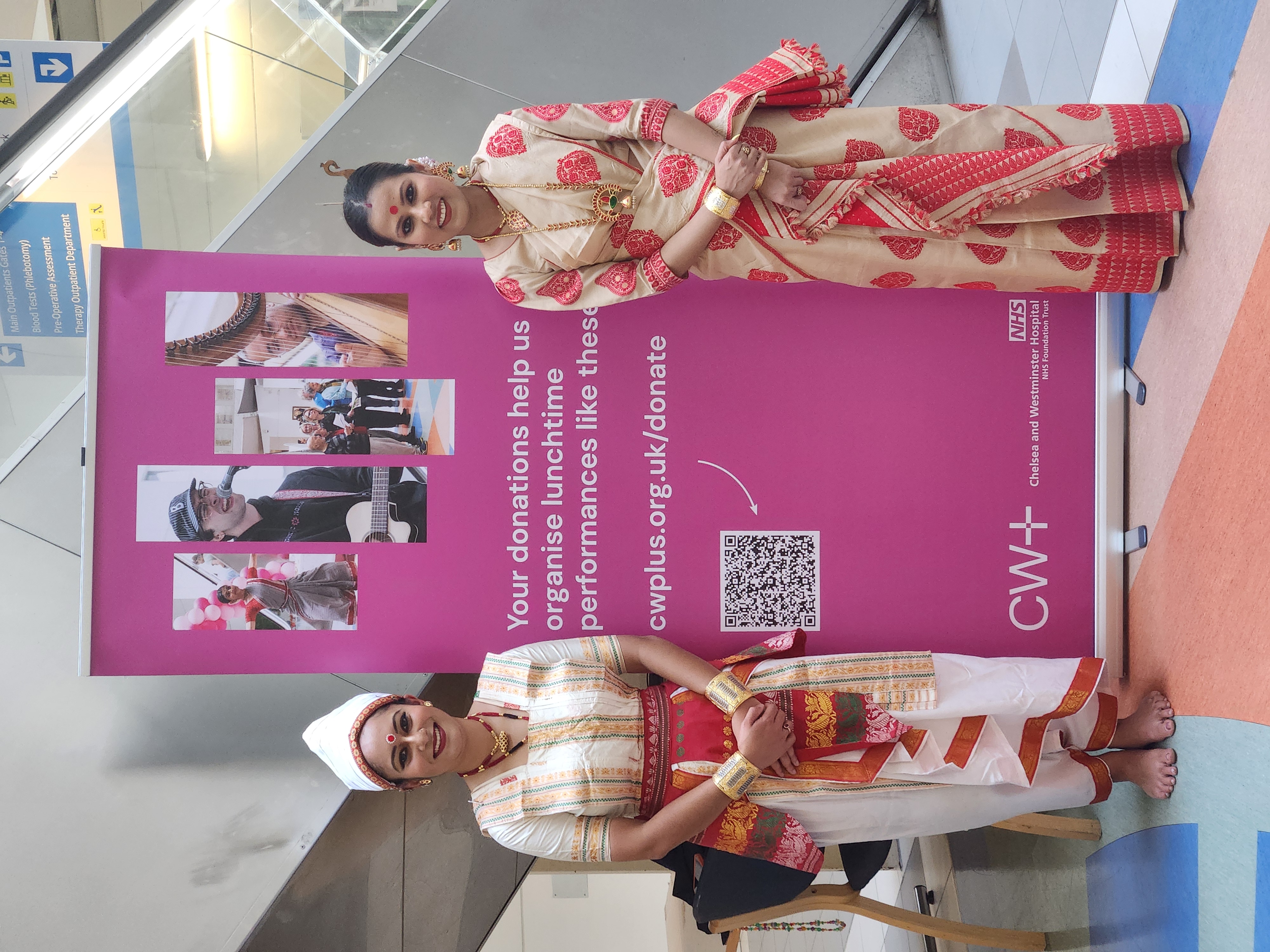
The bustling main atrium of Chelsea and Westminster Hospital in London became an unexpected stage for the rich artistic heritage of Assam on Thursday, 1 October 2026, as patients, visitors, NHS staff and members of the wider hospital community were introduced to the classical and folk dance traditions of the northeastern Indian state (Assam).
Presented under the banner of Akademi, one of the United Kingdom’s leading organisations dedicated to South Asian dance, the special lunchtime showcase brought together the spiritual refinement of Sattriya Dance and the exuberant vitality of Assamese folk traditions. The performance was led by two professional Assamese dancers based in the United Kingdom, Anannya Mahanta Jugnarain and Oonmona Das. The presentation formed part of the cultural activity at Chelsea and Westminster Hospital supported by CW+, the official charity of Chelsea and Westminster Hospital NHS Foundation Trust. Through its Arts in Health programme, CW+ has long championed the presence of visual art, music, dance and creative engagement within healthcare environments, seeking to make hospital spaces more welcoming and restorative for patients, families and staff.
The Assamese presentation unfolded in two distinct segments, each revealing a different dimension of the state’s remarkably diverse cultural inheritance. Oonmona Das led the classical segment through Sattriya, the major classical dance tradition of Assam whose origins lie in the Vaishnavite Sattras established in Assam from the fifteenth century onwards. Rooted in devotion, theatre, music and storytelling, Sattriya developed within the monastic tradition associated with the great Assamese saint and reformer Srimanta Sankardev, before gradually expanding beyond the Sattras and reaching wider audiences in India and abroad. Das offered the audience an intimate glimpse into this sophisticated tradition through measured movement, expressive gesture and changes in costume and characterisation. Her presentation explored both masculine and feminine dimensions of Sattriya performance, allowing the audience to witness the versatility of a tradition whose vocabulary can move seamlessly between strength, restraint, grace and devotional expression. For many watching in the hospital atrium, the performance offered a first encounter with an art form rarely seen in mainstream public spaces in Britain. The understated elegance of the recital, combined with its distinctive costumes, gestures and rhythmic language, created a striking contrast to the constant movement of an active hospital environment.
Anannya Mahanta Jugnarain led the folk segment, transforming the atrium with the colour, rhythm and celebratory spirit associated with Assam’s numerous communities and regional traditions. Her presentation drew inspiration from dance expressions associated with the Mising, Tiwa and Bodo communities, alongside Jhumoor and Goalpariya traditions, before building towards the unmistakable energy of Bihu. Through this carefully woven sequence, Mahanta evoked recurring themes within Assamese cultural life, nature, community, agriculture, courtship, celebration and the arrival of spring. The performance culminated in a spirited presentation of Bihu, one of Assam’s most recognisable cultural expressions. Traditional symbols and instruments, including the Japi, Toka and Gogona, were incorporated into the presentation, adding another layer of visual and cultural texture. The Japi, traditionally crafted from bamboo, cane and palm leaves, has evolved into one of the most widely recognised emblems of Assamese identity, while the Toka and Gogona remain closely associated with the soundscape and celebratory atmosphere of Assamese folk culture.
Together, the two artists offered the audience a journey across Assam, from the devotional world of the Sattras to the open fields, festivals and community traditions that animate its folk heritage. According to those present at the venue, including members of the hospital community and volunteers, the Assamese showcase was particularly memorable because many had not previously encountered the state’s dance traditions. The unfamiliarity of the forms became part of their appeal, as audiences paused in the atrium to watch traditions that were geographically distant, yet immediately communicative through movement, rhythm, colour and expression.
The setting gave the presentation an additional significance. Chelsea and Westminster Hospital hosts free lunchtime performances in its main atrium, creating opportunities for patients, visitors and staff to encounter live performance without having to enter a conventional theatre or cultural venue. Within this context, art becomes not simply entertainment, but an invitation to pause, connect and experience a moment of respite within an environment that can often be associated with anxiety, uncertainty and intense emotional pressure. This philosophy lies at the heart of CW+ and its Arts in Health work. The programme has its roots in the opening of Chelsea and Westminster Hospital in 1993 and has developed over more than three decades to encompass visual and digital art, live music and dance, participatory activities, creative workshops, environmental design and other initiatives intended to enrich the experience of healthcare.
Akademi has itself developed a substantial body of work bringing South Asian dance into hospitals and community settings. Its relationship with CW+ and Chelsea and Westminster Hospital stretches back approximately 25 years. Through its Dance Well programme and related initiatives, Akademi has sought to demonstrate how dance can provide moments of engagement, social connection, physical activity and emotional respite for people encountering healthcare environments. The organisation’s connection with Chelsea and Westminster Hospital can be traced through performances and participatory projects dating back more than two decades. Today, that relationship continues through hospital based programmes that take South Asian dance beyond the conventional stage and place it directly within everyday spaces.
For Assamese artists working in the United Kingdom, the 1 October presentation carried another layer of meaning. Assam possesses a vast cultural landscape encompassing classical dance, music, theatre, indigenous traditions, textiles, festivals and highly distinctive community practices, yet many of these traditions continue to receive comparatively limited visibility within mainstream presentations of South Asian culture overseas. Artists such as Mahanta and Das are contributing to a growing effort to change that visibility through performance, research, education and cultural exchange, while remaining attentive to the lineage and integrity of the traditions they represent.
Oonmona Das is an Oxford based artist-scholar and Indian classical dancer from Assam whose artistic practice encompasses Sattriya for nearly two decades and is currently undergoing training in Odissi. She studied Global and Area Studies at the University of Oxford and has previously introduced Sattriya to academic and public audiences through lecture demonstrations and cultural events in Oxford. Her work brings together an engagement with research and a longstanding relationship with Indian classical dance.
Anannya Mahanta Jugnarain is a United Kingdom based Sattriya and Bihu performer who has been engaged with these two dance forms for more than two decades. Prasar Bharati records recognise her as a graded artist in Sattriya under its Guwahati centre. Her professional work has also included performances, workshops and lecture demonstrations aimed at introducing Assamese dance to audiences in India and the United Kingdom. She is associated with SPIC MACAY as an empanelled artist for workshop demonstrations and is a member of the International Dance Council, an international dance organisation and official partner of UNESCO.
The meeting of these two artistic approaches gave the Chelsea and Westminster presentation its distinctive character. Sattriya brought contemplation, precision and spiritual depth, while the folk repertoire offered spontaneity, colour and communal exuberance. Together, they presented Assam not as a single cultural expression, but as a living mosaic of traditions.
In the middle of one of London’s busiest healthcare environments, the performance created something deceptively simple, a shared moment of stillness, curiosity and joy. For a brief period, patients, medical professionals, visitors and passers by gathered not around illness or treatment, but around rhythm, movement and heritage. In doing so, the showcase captured the enduring purpose of arts in health, transforming an ordinary public space into a place of connection and reminding its audience that culture, too, can offer comfort, conversation and a profound sense of human belonging.